
The advantages of distributed storage
The UK's energy transition needs storage, but where that storage goes, and who owns it, has an impact. Right now, lots of storage being connected is in the form of grid-scale battery farms: rows of batteries stacked in shipping containers, powered by large investors and energy companies. They have their place, but for lots of households and communities, distributed storage can be the better solution.
Why storage matters
The shift to intermittent renewable energy creates a timing problem: wind and sun sometimes provide power when the grid doesn't need it, and often the grid needs power when neither is available. Storage solves the problem. It soaks up excess renewable electricity when generation is high and supplies it when generation is low. Done well, storage makes renewables viable at scale.
This benefits everyone: lower carbon energy, lower dependence on volatile fuel prices, more stable grids, reduced waste of homegrown energy. But how storage is deployed determines who benefits, and who bears the costs and impact.
Grid-scale battery farms
When developers propose a grid-scale battery farm, local communities typically object. We could complain about NIMBYs simply not wanting any sort of development near them but the concerns people have are legitimate.
First, the visual impact. A battery farm near your home (rows of shipping containers, high fencing, industrial transformers, access roads) is a visible presence that changes the landscape. For communities that don't benefit directly, it's a difficult trade-off to accept. The construction jobs are temporary and the financial return goes to the project developer or energy company, not the residents who live nearby.
Second, there's the utilisation problem. The Energy Networks Association analysis of industrial-scale batteries across the UK found that installations only had 4.6% capacity utilisation. In other words, 95% of the time, approximately 80% of the contracted capacity sits idle. The batteries are designed with "firm" access rights to the grid (they can import or export at full power whenever they choose), but they rarely actually do so. They're only profitable to operate when the price gap between cheap and expensive electricity is wide enough. Therefore, most of the time, they wait.
Compare this to other grid users: solar installations average 11% utilisation, wind 22%, and domestic customers and industrial users both around 51%. Battery farms are the least-utilised infrastructure on the system.
This idle capacity has created a bottleneck. Over 70% of UK grid supply points are now constrained, partly because battery farms have reserved large amounts of network capacity they barely use. Meanwhile, homeowners wanting to install heat pumps and EV chargers, infrastructure that would actively decarbonise their homes, sometimes face delays and additional costs.
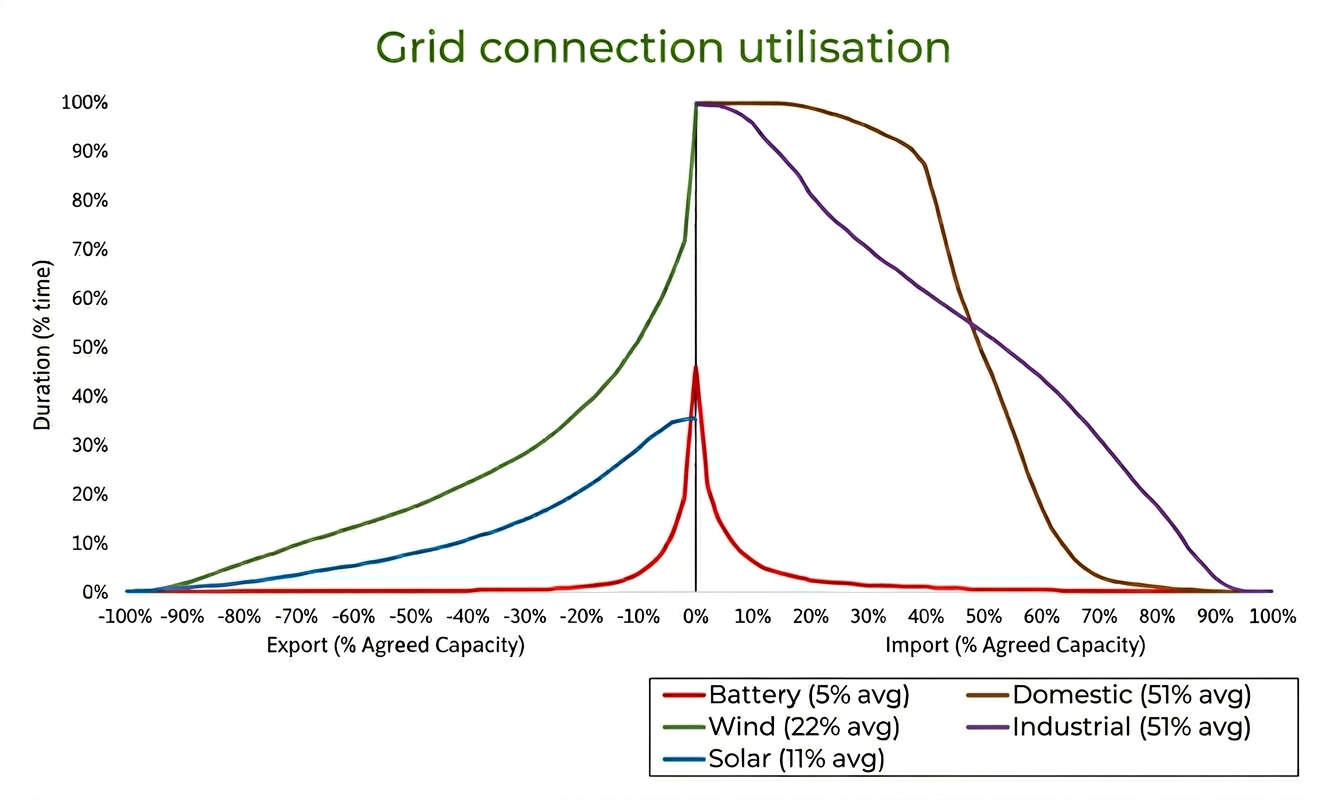
How well utilised are different types of grid connection? Grid-scale battery farms only use a fraction of their grid connection capacity most of the time and in an unpredictable manner, restricting what other generation or consumption can be connected before grid upgrades are required. Figure & data from the ENA.
Why distributed storage wins
1. Energy stored where it's needed
When a household installs a battery, the stored electricity is used locally. The battery charges when the grid is cheap (typically overnight, when demand is lower) and discharges when it's expensive. The household then uses that electricity directly.
A grid-scale battery farm isn’t a high consumer of electricity, its primary role is to buy-low and sell-high and help balance the grid. The stored electricity has to travel across the grid again to be used elsewhere, whilst a domestic battery located where the energy is actually used eliminates that second journey.
More importantly: distributed batteries don't need new grid infrastructure. They connect to existing household supplies, using capacity that's already been paid for. A grid-scale farm requires new or upgraded substations, new infrastructure or sometimes new connections to the transmission or distribution system entirely. These upgrades can be expensive, slow and trigger exactly the network constraints we're seeing now.
Deploying storage in homes means existing network capacity goes further, fewer grid upgrades are needed, and those upgrades are more targeted and efficient. The same grid infrastructure can support more UK-generated renewables because the network is being used smarter, not just bigger.
2. The customer gets the direct benefit
This is where grid-scale and household batteries differ most clearly.
A grid-scale battery farm stabilises the grid and provides important services (frequency support, voltage management, emergency capacity). But those benefits are systemic and spread out over the whole network. The electricity price signal it provides helps all customers to some degree. The nearby residents see the infrastructure but barely notice the benefit. Most of the financial value flows to the developer or the energy company that owns the asset.
A household battery delivers a direct and tangible benefit to the homeowner. You install it, you see your bills go down, and you capture the economic value. You're not relying on diffuse network benefits; you're seeing the return on your investment. This is more equitable and provides a better incentive: if people can benefit personally, they're more likely to support storage that helps everyone.
It also empowers individuals to make their own decisions. Instead of centralised businesses, government or large landowners deciding where storage should go based on financial returns, individual households make local decisions based on their own circumstances.
3. Avoiding the land-use cost
Grid-scale battery farms take up space and are often built on greenfield sites. The loss of visual amenity and construction disruption are common complaints by local residents.
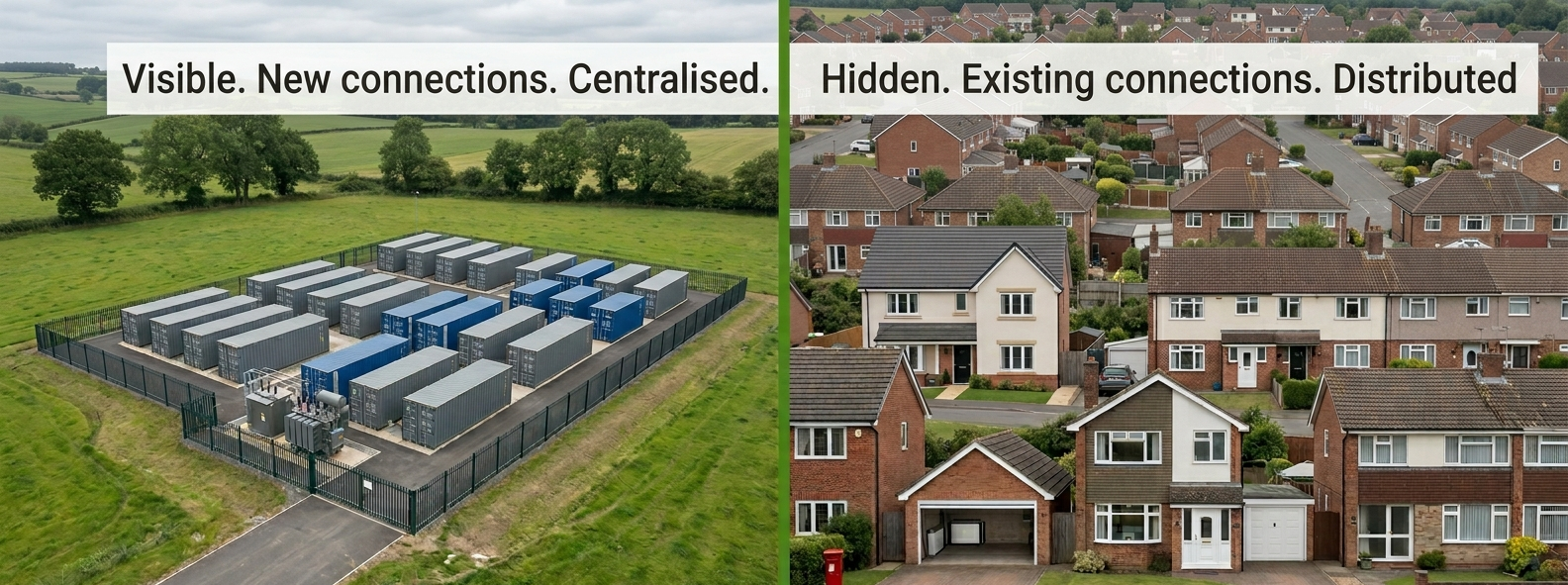
Distributed household batteries use existing buildings and grid connections. A battery sits in a garage or utility room, with no visual or local environment impact beyond a square metre of existing floor-space. By choosing distributed storage, we meet the need for energy storage by using infrastructure that's already there and making better use of what we've already built.
4. Efficiency is size independent
Unlike some energy infrastructure, batteries do not get more efficient with scale. Some generation, like wind turbines or fossil fuel power stations, only make sense above a certain size and in certain locations. Battery storage works just as efficiently in a 16kWh system installed in a single household as it does in a field filled with shipping containers. The individual units, the “cells”, are now commodity products manufactured at scale. The same cells that go into domestic storage are the same cells that go into row-after-row of grid-scale battery farm capacity.
Grid-scale batteries still have a role
This isn't an argument against grid-scale batteries entirely, they do something distributed batteries can't.
Because a battery farm isn't tied to a household's load, it can be charged and discharged at much higher capacities. A 16kWh household battery might shift 10-15kWh per day. A 50MW grid-scale battery can provide 50MW of power virtually instantaneously, many times per day. It provides services (frequency response, voltage support, grid inertia) that individual batteries can't collectively deliver at the same scale or speed.
For truly grid-level challenges, grid-scale storage provides a reliable, high-capacity response. Distributed batteries have physical constraints: they can only export the power they're not already supplying to the house they're connected to.
So grid-scale storage has a role and the UK needs some. But it best fits into the system when it’s deployed strategically, where it provides unique grid services, not as the default solution to the energy storage problem.
What about pumped hydro?
If energy storage is the answer to UK making the most out of our homegrown renewables, pumped hydro should be the obvious route. It's proven, reliable, and can operate for days without degradation. The UK currently operates four pumped hydro stations totalling around 2.9GW of capacity, with an additional 2.4GW given planning consent and a further 2.8GW currently awaiting consent.
Location, location, location
Pumped hydro sounds like the obvious choice because it requires almost no raw materials beyond water and gravity. But that's exactly the problem: you need specific locations with both.
There are few places in the UK that are suitable for pumped hydro storage and unfortunately many of those are remote and wild. Suitable sites require dramatic elevation changes over a manageable distance, existing water sources, and geology stable enough to hold reservoirs. Most of those locations happen to be in protected landscapes: the Scottish Highlands, the Lake District or Snowdonia. Environmental concerns, such as the impact on ecosystems, are often raised, and many of the most suitable sites are in sensitive or protected areas.
Engineering cost & complexity
Building pumped hydro isn't just a matter of planning and approvals. After a suitable location is identified the detailed engineering work begins because each site is unique. The tunnelling, water management, structural engineering, and environmental mitigation differ significantly between locations. This complexity is why pumped storage hydro requires long construction times and high capital expenditures, which do not match well with market-driven mechanisms for cost recovery.
Yes, and…
As with most energy transition challenges the answer to whether a particular technology should be used is “yes, and”. We will need more than one set of technologies to meet the energy demands of the future. To say that a single option solves every problem misses the key benefits that complementary solutions provide. Pumped hydro provides unique benefits, such as grid inertia and multi-day storage, and should be expanded where it can be done appropriately. Grid-scale battery farms can also provide grid-scale stability services and are much less geographically constrained than pumped hydro.
In contrast, distributed batteries can be scaled quickly, cost-effectively and co-located exactly where energy is consumed but realistically can’t provide grid-level stability services purely on their own. However, empowering individuals to make their own decisions about where storage is located and enabling them to share directly in the benefits of providing energy flexibility is a unique advantage of distributed storage.